

Holding Summer In A Jar: Savory-Sweet Strawberry Thyme Jam
There is a particular hour in fall when the air turns brisk. The kitchen is filled with the harvest and now the work of preserving begins. Windows are fogged, a wide pot is murmuring on the stove, and the whole house seems to lean toward the sweetness rising from it. If you have ever stood over simmering berries and felt the day grow quiet around you, you already know what I mean.
This is the season of gathering in. The days are still long enough to feel generous, but there is a soft edge to the light now, a reminder that the garden will not give forever. Where I live, summer arrives late and leaves early, and we learn to treasure every ripe thing. Perhaps that is why preserving has always felt to me less like a chore and more like a small act of tenderness: a way of saying, this was good, and I want to keep it.
Why Strawberries and Thyme
Strawberries taste of warmth and bright days and steal our attention when walking by. When spotted, they're the first treasure to go. Thyme, on the other hand, grows low and steady, asks for almost nothing, and gives back a soft, green, woodland note that makes the fruit taste more like itself.
Together, they are something like a conversation between the sunny part of the garden and the shady corner beside it. The thyme does not shout over the strawberry. It simply deepens it, so that each spoonful tastes a little more like a whole summer afternoon.
An Old Kind of Kindness
Before there were grocery stores and freezers, people carried the harvest through winter in jars. They made jam in the same unhurried way, with a wooden spoon and a good pot, watching for the moment the fruit turned glossy and began to hold its shape. There is wisdom in that rhythm. You cannot rush jam. You stir, you wait, you listen to the pot, and somewhere in that stillness you find that your own shoulders have dropped.
I love that jam asks us to be present. It rewards the small rituals: chilling a plate in the freezer to test the set, tying the thyme into a little bundle, wiping each rim clean before the lid goes on. These are not obstacles to the recipe. Perhaps they are the recipe.
A Few Gentle Notes Before You Begin
Preserving is a beautiful craft, and it is also a science, so I like to honor both. Jam is safe to keep on the shelf because it is acidic, which is why this recipe includes a measure of bottled lemon juice. I would encourage you not to reduce it, and to follow the processing times as written, adjusting for your altitude. Use jars made for canning, check your seals the next morning, and if a lid ever seems unsure of itself, simply tuck that jar in the refrigerator and enjoy it within a few weeks.
This jam has a soft, spoonable, old-fashioned set. If you prefer something firmer, a commercial pectin can help, though you will want to follow the box exactly.
What the Jar Becomes
One of my favorite things about putting up a harvest is the moment, months from now, when you open a jar on some dark, quiet morning. The lid gives its small, satisfying sigh, and suddenly it is summer again. The color is bright, the thyme is faint and green, and you remember the warmth of the day you made it.
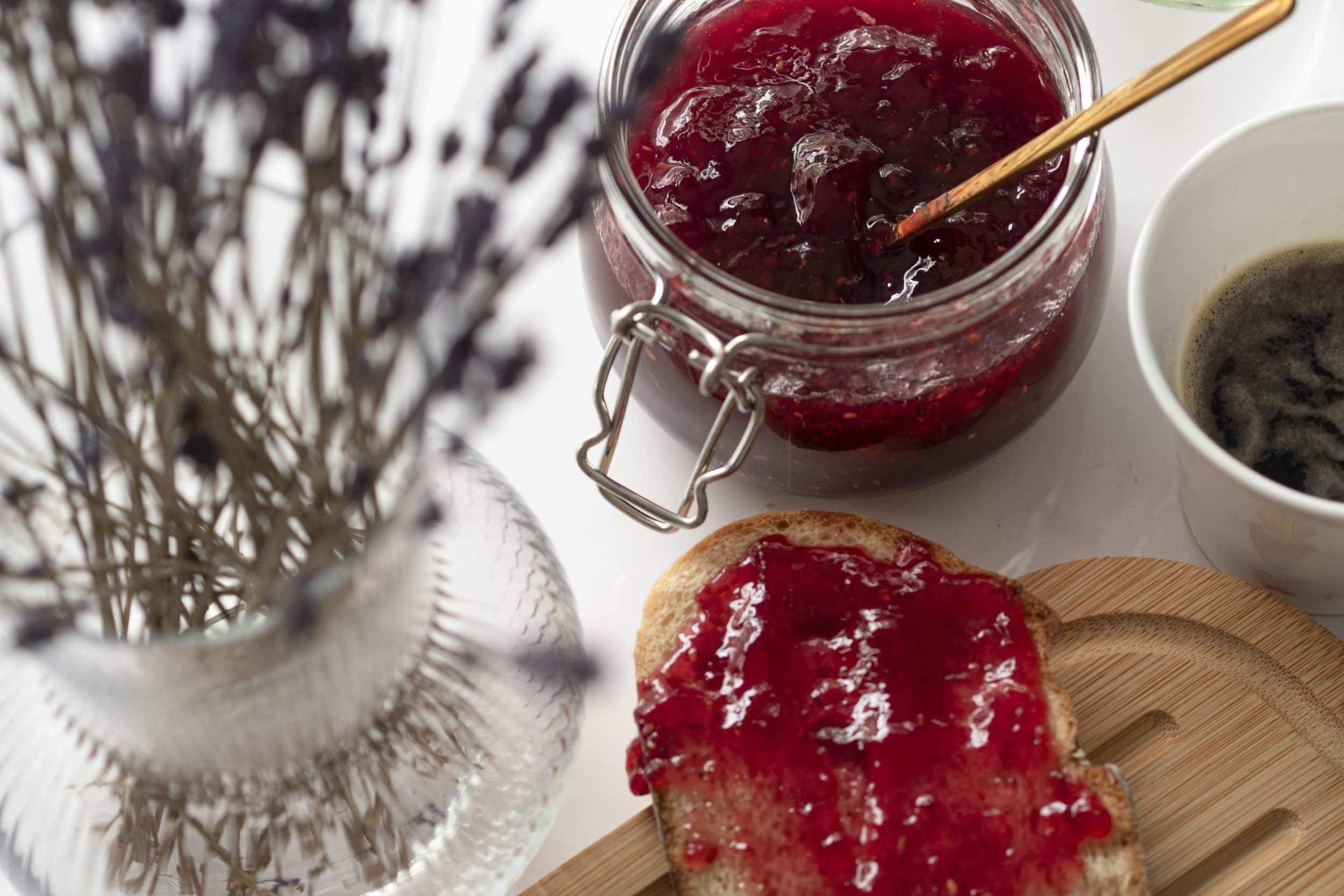
Spread it on warm toast or a buttered biscuit. Stir it into yogurt. Set a spoonful beside a soft cheese and some crackers. Or give a jar to someone who might need a little sunlight, because sometimes the kindest thing we can offer one another is something we made slowly, with care.
The full recipe is waiting for you below. I hope it fills your kitchen with the same sweetness it has filled mine, and I hope it carries a little of this season all the way through winter.
With warmth,
Jen
Strawberry-Thyme Jam
By: Jen Merrell @everyday__sage
A small-batch, old-fashioned jam with a whisper of fresh thyme. Perfect for savory lovers, harvest season, and for filling your pantry.
Makes: 3 to 4 half-pint (8 oz) jars | Active time: about 45 minutes | Water-bath processing: 10 minutes
Ingredients
2 lb strawberries, hulled and mashed (about 4 cups mashed)
3 cups granulated sugar
1/4 cup bottled lemon juice
6 sprigs fresh thyme (lemon thyme is lovely), tied with kitchen twine
1 tsp finely minced fresh thyme leaves
Pinch of salt (optional)
Equipment
Water-bath canner with rack, 4 half-pint canning jars, new lids and bands, jar lifter, funnel, ladle, headspace tool or ruler, candy thermometer, and 2 to 3 small plates chilled in the freezer.
Instructions
Prep. Put the small plates in the freezer for the gel test. Wash jars, lids, and bands in hot soapy water. Fill the canner about halfway, add the jars, and bring to a gentle simmer to keep them hot. Keep lids warm per the manufacturer's directions.
Macerate. In a wide, heavy-bottomed pot, combine the strawberries, sugar, lemon juice, salt, and thyme sprigs. Stir and let stand 30 minutes (or refrigerate overnight for deeper flavor).
Cook. Bring to a boil over medium-high heat, stirring until the sugar dissolves. Mash the berries to your preferred texture. Continue at a full rolling boil, stirring often and skimming foam, for 15 to 25 minutes, until the jam reaches 220°F (8°F above the boiling point of water at your altitude).
Test the set. Spoon a little jam onto a frozen plate and return it to the freezer for 1 minute. Push it with your finger. If it wrinkles, it is ready. If it runs, keep cooking and test again.
Finish. Remove from the heat. Discard the thyme sprigs, stir in the minced thyme leaves, and skim off any remaining foam.
Fill. Ladle hot jam into hot jars, leaving 1/4 inch headspace. Slide a thin spatula around the inside of each jar to release air bubbles. Wipe the rims clean, set on lids, and screw on bands fingertip-tight.
Process. Lower jars into the canner so water covers them by 1 inch. Cover, bring to a full rolling boil, then start your timer: 10 minutes at 0 to 1,000 ft; 15 minutes at 1,001 to 6,000 ft; 20 minutes above 6,000 ft. Turn off the heat, remove the lid, and rest 5 minutes.
Cool and check. Move jars to a towel and leave undisturbed 12 to 24 hours. Press the center of each lid: a sealed lid does not flex. Refrigerate any unsealed jars and use within 3 weeks. Remove bands, label, and store sealed jars in a cool, dark place up to 12 months. Refrigerate after opening.
Tips & Variations
Softer set: this is a soft, spoonable, old-fashioned jam. For a firmer or lower-sugar jam, use commercial pectin and follow the box's fruit-to-sugar ratio exactly.
Do not double the batch. Large volumes cook unevenly and may fail to set.
Flavor twists: try lemon thyme, a split vanilla bean, a splash of balsamic vinegar, or a few cracks of black pepper at the end.
Enjoy it on: warm biscuits, thick yogurt, goat cheese and crackers, or swirled into oatmeal.
Canning Safety Basics
Jam is a high-acid food, so it can be safely processed in a boiling-water bath. The bottled lemon juice in this recipe provides the acid that keeps it safe and helps it set. Do not reduce it, and use bottled, not fresh, because its acidity is consistent.
Always use jars made for canning, new lids, and the correct headspace.
Adjust processing time for your altitude, as shown in step 7.
Discard any jar with a bulging lid, leaking, mold, or an off smell, without tasting it.
Unsure about a jar's seal? Store it in the refrigerator and enjoy it within 3 weeks.
Before canning, compare processing times against current tested recipes from the National Center for Home Food Preservation (nchfp.uga.edu) or your pectin manufacturer.
